
Sets & makers · American mahjong
When a jellyfish becomes a dot.
Sea life, beach huts and a flash of pink. A closer look at Bam Good Time’s Miramar tiles, and the founder whose story began around her kitchen table.
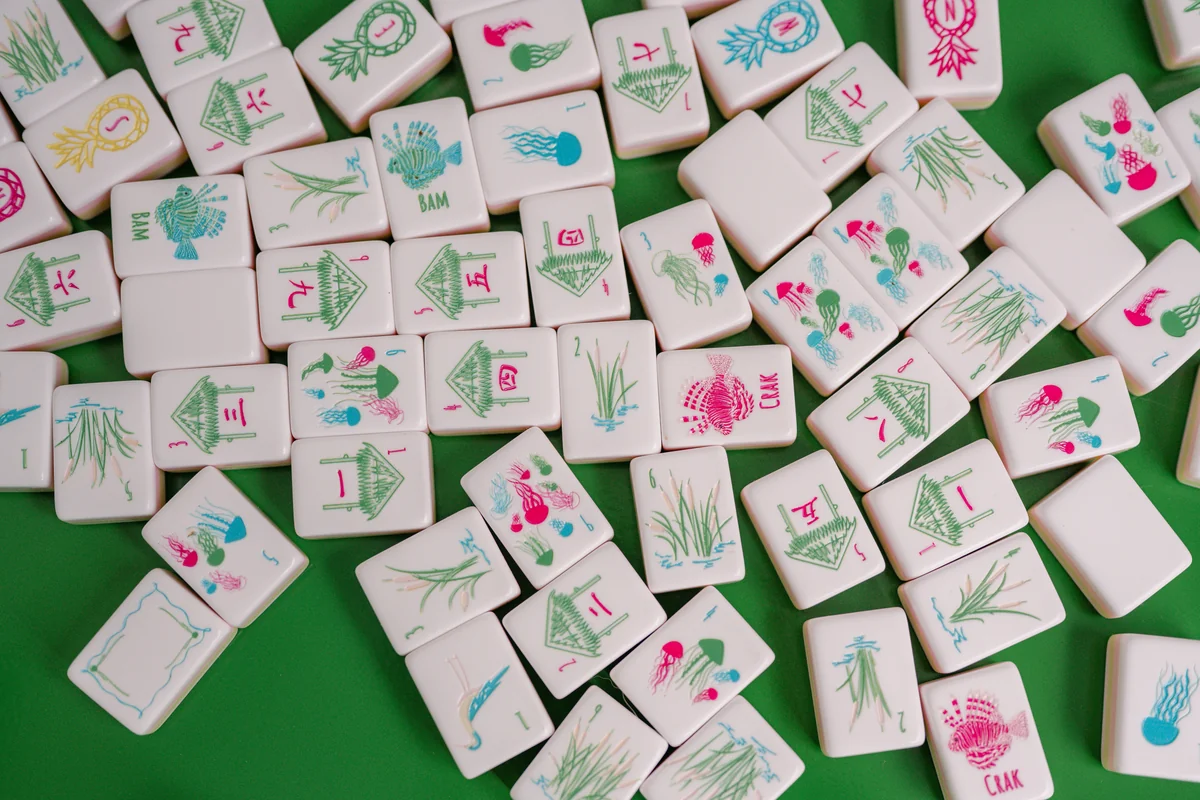
Start with the turquoise jellyfish. Its tentacles trail across a white tile; a small 1 sits in the corner. Nearby, several jellyfish share a face. There is a picture to enjoy and a number to read.
Miramar, a coastal collection from Bam Good Time, gives familiar mahjong symbols a different appearance. Look closely at the photographs and a design question emerges: what helps you recognise a tile when its illustration changes?
Three ways to read a tile
Courtesy of Bam Good Time. Detail views cropped.
The dot tiles offer the most immediate answer. Their jellyfish form small groups, with a corner numeral providing another route to the value. The bamboo suit has a different silhouette: slender green reeds. On the character tiles, pink Chinese numerals sit inside the outlines of green beach huts.
Each family establishes its own visual pattern. The jellyfish have rounded bodies and trailing lines; the reeds gather into narrow stems; the huts place a frame around a character. Those differences give the eye something to follow across a handful of scattered tiles.
The winds make the relationship especially clear. A pineapple surrounds a letter — N, E, S or W — which identifies the direction. On the one-bamboo tile, the maker identifies the long-legged bird as a sandpiper. It is another small connection to the collection’s coastal setting.
It began around a kitchen table
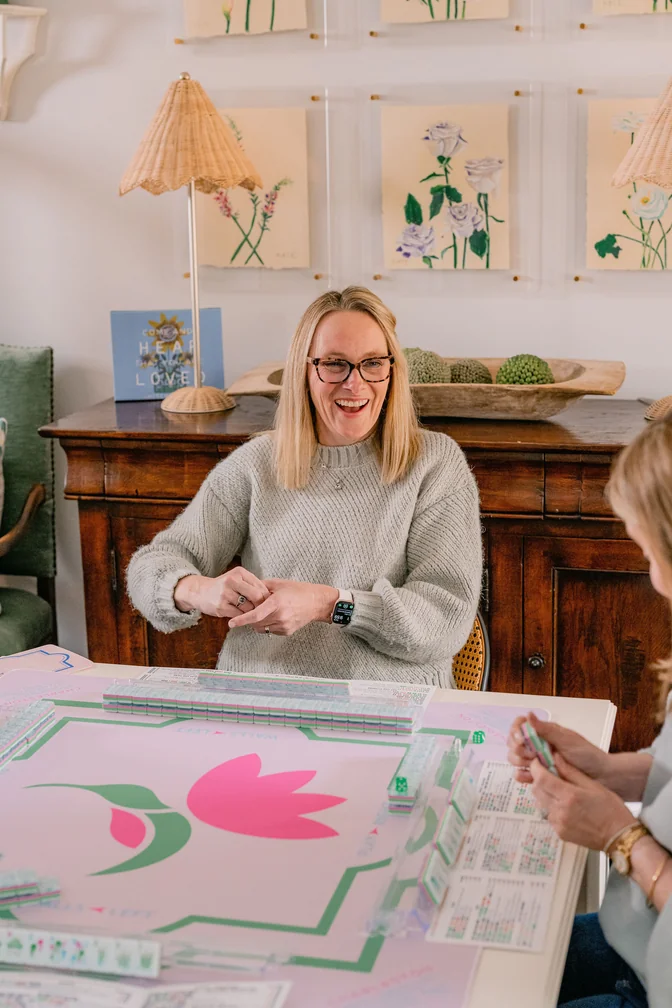
In her account of starting Bam Good Time, founder Heather Cannon places the beginning at her own kitchen table in Columbus, Georgia. She describes building the business with her husband, Sterling, and spending her time teaching, calling tiles and welcoming players. The company also organises local classes, leagues and events.
Eliza Morrill’s portrait brings a person into the story. Heather sits behind a rack at a pink-and-green table, with another player partly in view. Beside the close-up of scattered tiles, the photograph changes the scale: the small illustrations become part of a shared table.
A single motif catches the eye. Across a rack, the differences between the suits matter too. The photographs invite both kinds of looking.
The colour continues around the edge
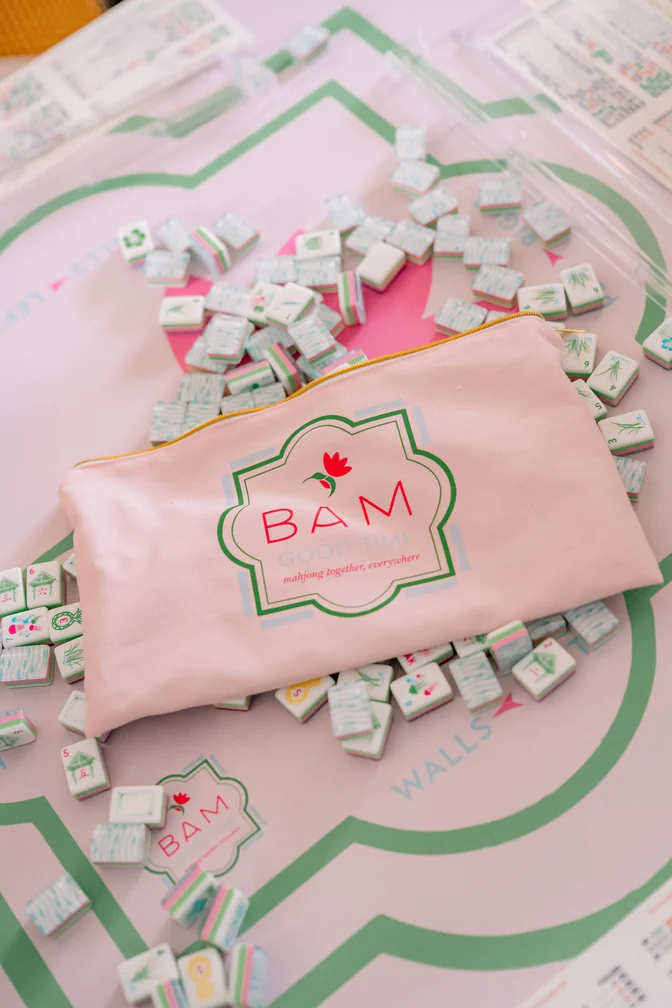
In the table photograph, tilted tiles reveal pink and green bands around their sides. Some lie face down, showing pale blue patterned backs. A pink pouch sits among them, echoing the colours of the mat beneath it.
The face is only one visible surface. When pieces stand in a rack or lie waiting on the table, their sides and backs become part of the scene too. Looking across all three photographs connects the small drawings to that larger arrangement of colour.
Go back to the jellyfish. Find its number, then look for the same value in another suit. That small switch — from noticing a picture to recognising a tile — is a good place to begin exploring Miramar.
The set at a glance
- Collection
- Miramar
- Company
- Bam Good Time
- Variant
- American mahjong
- Material
- Acrylic
- Maker’s listed contents
- 160 tiles, including 10 jokers and 6 blanks
Sources
- Bam Good Time press kit and photographs
- Heather Cannon’s account
- Miramar collection and set inventory
- Miramar tile listing
Sources checked .