
History & play
The Card That Changes American Mahjong Every Year
For players who follow National Mah Jongg League rules, a new card brings new hands to the same table.
By August, next year’s game was already on the table. In July 2016, Ellie Gettinger of the Jewish Museum Milwaukee published an account of how the National Mah Jongg League made its annual card. At the League’s New York office, David and Larry Unger told her that a group of women brought in ideas for winning hands, played through variations and revised them until November, when they settled on the next year’s card. After it went out, volunteers answered questions from players trying to read the new hands.1
For American Mah Jongg played by League rules, the card is the year’s reference for winning hands. It gives their values and carries some rules and reminders. The League publishes a separate instruction book for learning how to play. Its 2026 card measures 5⅛ × 4 inches in the standard size and 6⅛ × 4¾ inches in large print.2
From table to table
A card you could carry
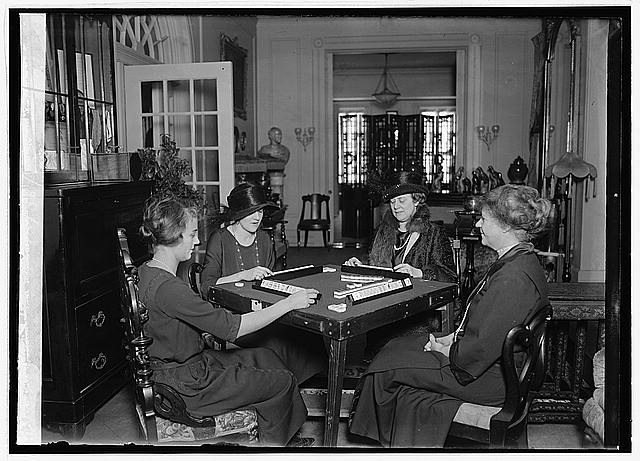
Mahjong came from China, and Americans were already gathering around its tables before the League existed. In a photograph dated December 30, 1922, four people sit around a table with rows of tiles in front of them. The Library of Congress catalog identifies the game as mahjong. The players’ names and their rules are unknown.3
-
Before the League
The archive photograph shows a mahjong game. The rules the players used are unknown.3
-
A shared reference
A group of Jewish women in New York establishes the National Mah Jongg League.4
-
A night each week
Marjorie Meyerson Troum recalls playing weekly with friends after her marriage.9
-
Behind the annual card
Ellie Gettinger reports how volunteers tested hands from August to November.1
-
Two print formats
Standard measures 5⅛ × 4 inches. Large print measures 6⅛ × 4¾ inches.2
By the League’s account, groups in the United States had been making up their own winning combinations. In 1937, a group of Jewish women in New York founded the National Mah Jongg League to establish shared hands and rules. Gettinger describes players taking the card to gatherings in the Catskills and Miami. The women they played with took it home, too. A common set of hands made it easier to sit down with people from another group.4
The League issues a fresh card each year. At the start of play, players still have the Charleston, an exchange of unwanted tiles. Once they look for a hand to build, they work from the current card. Someone who knows the game well may still have to stop and read a line twice.5
How to read fourteen tiles in one line
A winning hand has fourteen tiles. A repeated number can show a group of matching tiles. Letters stand for tiles such as flowers and dragons, and a note in parentheses can specify which numbers or suits will work. The blue, green and red ink lets a reader tell which suited groups have to match and which have to differ. Where the hand leaves the choice open, two numbered groups in green could both be dots, bams (bamboos) or craks (characters). Their shared color tells you to use the same suit for both groups. A third suited group printed in a different color must use a different suit.6
Then there’s zero. In hands that spell out a year such as 2026, the white dragon, often called the soap, takes the place of the missing digit. Its outlined face can look rather like a zero. A dragon used to match a suit has a fixed partner. Green goes with bams, red with craks and white with dots. When the white dragon stands for zero, it has no suit. The card prints zeros, flowers and winds in blue. All three are suitless.7
Those few characters can carry a lot of instructions. The League’s members can still ask it about specific hands or bring it a dispute, the kinds of questions Gettinger found volunteers answering by phone in 2016.8
A night worth keeping
When historian Annelise Heinz interviewed Marjorie Meyerson Troum in 2012, Troum recalled growing up watching mahjong. Her mother had helped found the League. After Troum married in 1949, she played with friends once a week. Her husband, who expected dinner when he came home, was willing to make an exception for one game night. Heinz also describes a New Jersey suburb where husbands stayed home on Thursdays so their wives could go out to play. For those women, a regular game meant securing a regular night for it.9
The League has a calendar of its own. Its 2026 membership year runs from April 1, 2026, through March 31, 2027. In Kings Park, New York, the Smithtown Library listed an intermediate class for October 21. The library would provide the sets. Players were asked to bring their 2026 National Mah Jongg League cards.10
Sources & image rights
-
01
The making of the annual card
Back to passage ↑ -
02
Hand values, the instruction book and card formats
Back to passage ↑ -
03
Mahjong in America and the 1922 photograph
- League overview of the game
- Library of Congress photograph, item record mirrored on Wikimedia Commons
- Library of Congress, photograph record
- Archival JPEG
- Collection rights statement
-
04
The League and a shared card
Back to passage ↑ -
05
The annual card and the Charleston
Back to passage ↑ -
06
Reading the notation
Back to passage ↑ -
07
The white dragon in the 2026 card
Back to passage ↑ -
08
Help with hands and rulings
Back to passage ↑ -
09
Marjorie Meyerson Troum’s account
Back to passage ↑ -
10
The membership calendar and a library game
Back to passage ↑

