
How to Read a Mahjong Flower Tile
Eight picture tiles carry the seasons and four plants familiar from ink painting. Two sets show where to look for clues, and two rulebooks explain what happens when you draw one.
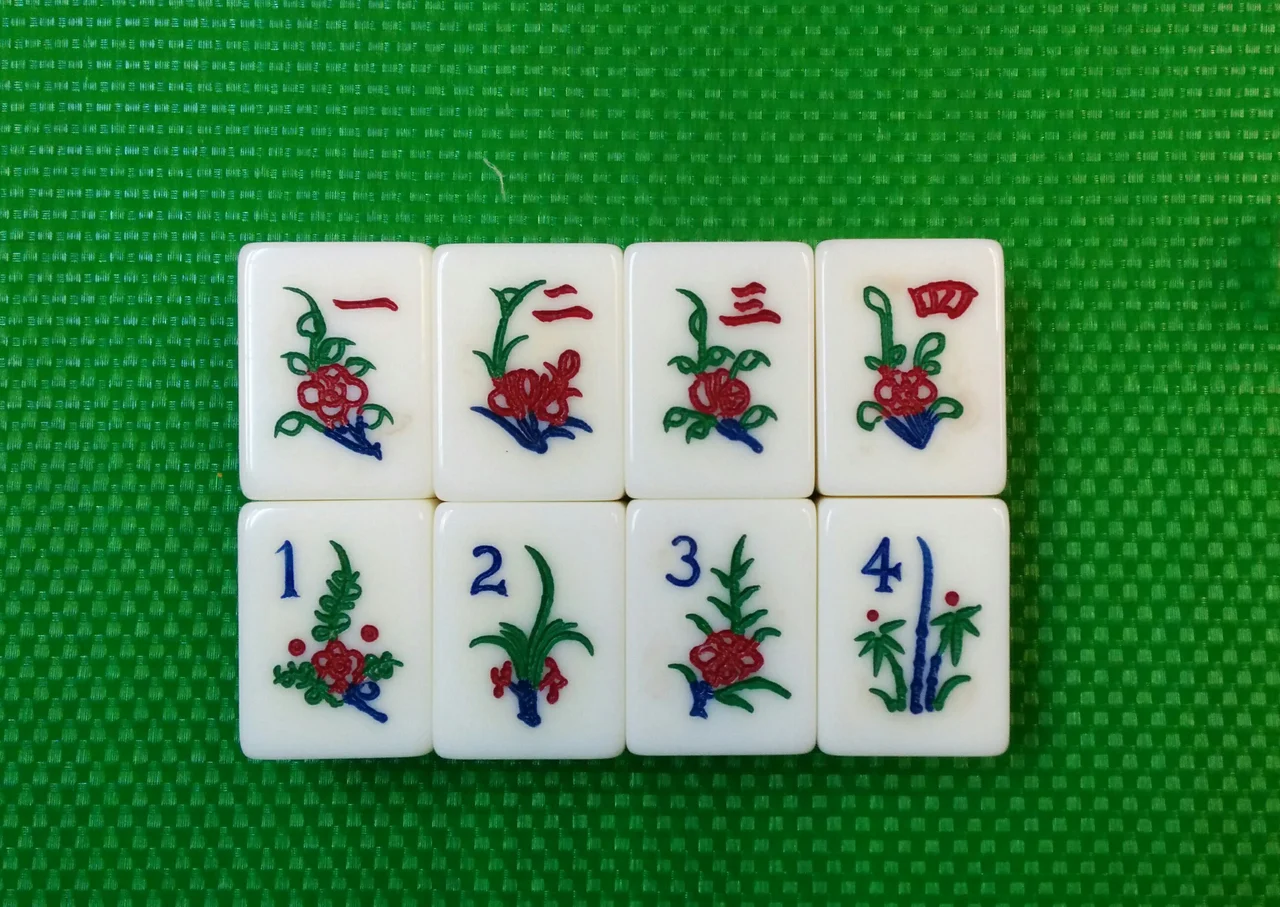

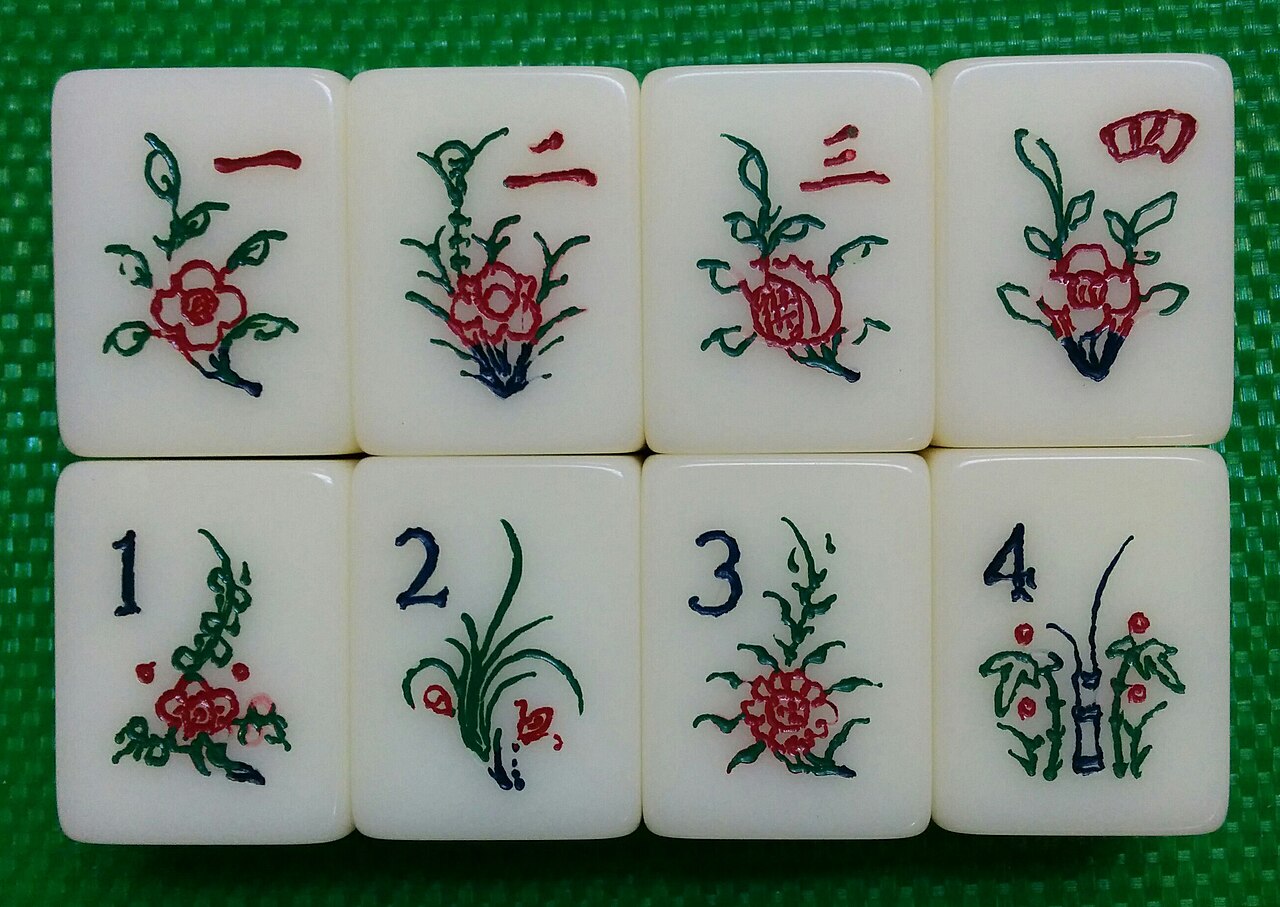

The first column of Cangjie6’s photograph of a Hong Kong mahjong set gives you two ways to write the number one. The upper tile bears a red 一, a single horizontal stroke. The lower one carries a blue 1. Both are decorated with red blossoms and green leaves. Each begins its own sequence of four. In Cangjie6’s photograph of a Canton set, the numbers fall in the same places, but the outlines of the plants are finer.1
Find the two sets of four
Start with the repeated numbers. In both photographs, the upper row reads 一, 二, 三, 四 in red and the lower row reads 1, 2, 3, 4 in blue. Each tile is a different design, even where two carry the same number. That pattern helps you sort an unfamiliar set. The numbered suits normally give you four matching copies of each design. In the flower group, each face appears just once. A single plant is a less reliable clue. The one-bamboo suit tile, for instance, can carry a bird.2
The photographer identifies the two groups as the Four Seasons and the Four Gentlemen. Where a set spells out the seasons, read them as a sequence. 春 is spring, 夏 is summer, 秋 is autumn and 冬 is winter. Here, the plants are picked out in red, green and blue, and the faces carry numbers in place of those four words. Once you have the two sequences, look for more distinctive shapes. In both lower rows, long leaves arch across tile 2. A densely petalled bloom fills the centre of tile 3. On tile 4, the stem has the visible joints of bamboo. Compare those shapes before trying to identify every flower.3
The orchid leaves the box
Plum blossom, orchid, bamboo and chrysanthemum form the quartet known as the Four Gentlemen in East Asian literati painting. The Hong Kong Palace Museum’s account of Wong Kwan Shut’s The Four Gentlemanly Plants gives a sense of what those motifs could carry. It associates plum blossom with resilience, the orchid with integrity, bamboo with humility and the chrysanthemum with retreat from public life. Those associations come from painting, where a few strokes of a brush can suggest the plant they stand for.4
At the Metropolitan Museum of Art, the Korean painter Kim Gyujin’s early twentieth-century Orchids in Hanging Basket gives the orchid the length of a hanging scroll. The basket tilts forward and the dark leaves spill over its edge. The Met reads the orchid as a symbol of virtue. Look back at the blue 2 in either photograph and follow the longest line from the base of the plant. It is easy to see how much of the shape those few arching leaves can carry.5
A letter from 1875
A spring tile with different neighbours
In a letter dated August 18, 1875, George Bunker Glover described a tile set that went to the American Museum of Natural History. His inventory lists four season tiles by their characters. After the seasons come four rulers of the directions and a second quartet that includes the Heavenly Ruler and the Earthly Ruler. When tile researcher Michael Stanwick examined the museum’s set, spring was among the pieces missing. Its name survives in Glover’s handwriting.6
You can see a spring tile in the photograph of a related set at the Brooklyn Museum. The four season characters (春, 夏, 秋 and 冬) run down the seventh column from the left in red, with the two ruler groups on their right. Stanwick and museum staff traced a likely link between Brooklyn’s set and a separate set collected by Glover. The 1875 letter describes the American Museum of Natural History set. Stanwick studies both surviving sets as possible precursors to modern mahjong. The seasons are familiar. Their company in the old set is less so.7
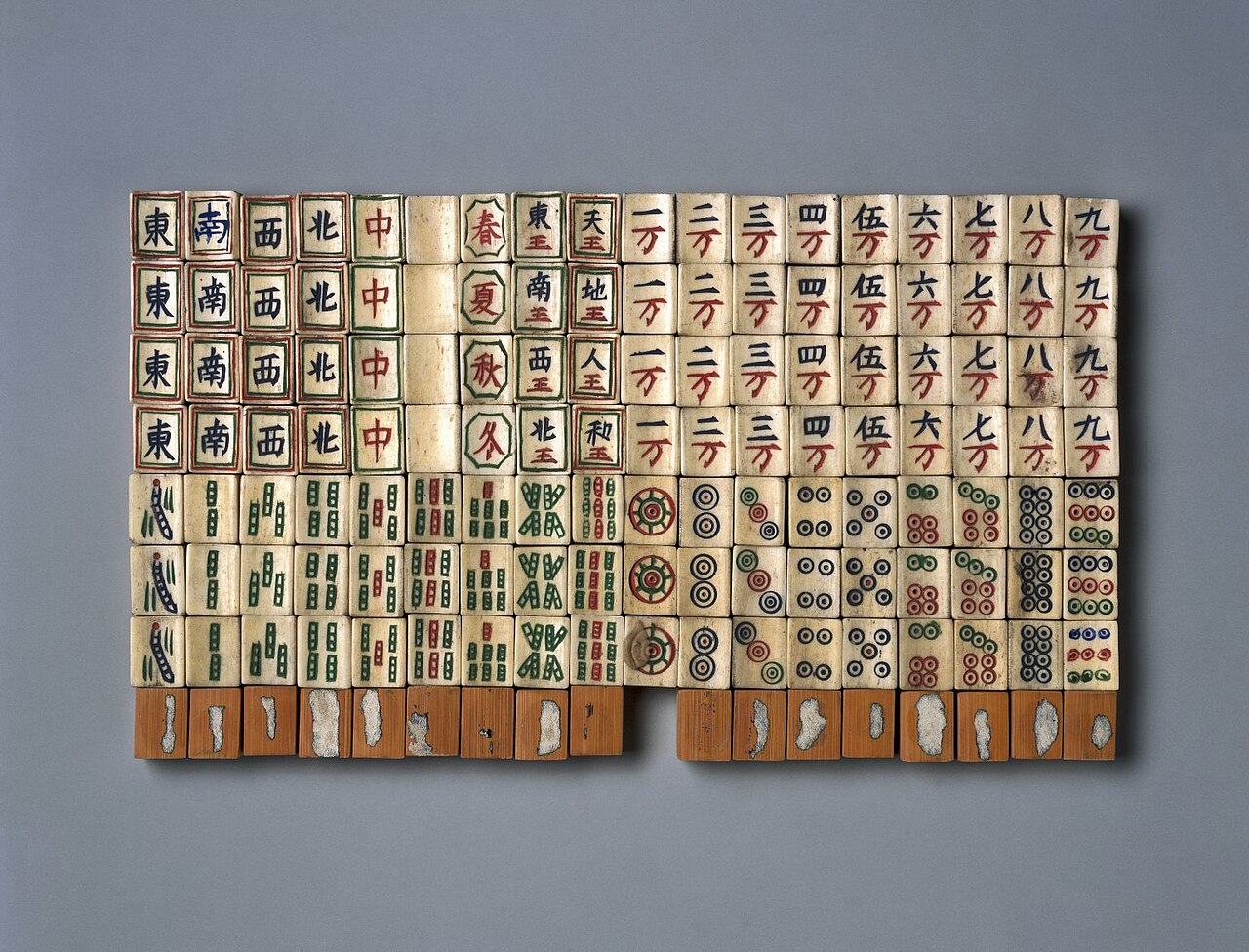

See the full collection photograph
What happens when you draw it?
In the World Mahjong Organization’s Mahjong Competition Rules, the 144-tile playing set counts all eight pictures as Flowers. If you draw one during play, you can call hua, put the Flower face up and take a replacement from the back of the wall. You can repeat the process if the replacement is another Flower. The rules also allow you to discard a drawn Flower without replacing it.8
Each Flower you reveal adds one point to a winning hand. To declare a win, the rest of the hand must already be worth at least eight points. A hand worth seven points and two revealed Flowers still falls short. At eight points, those same Flowers bring the hand’s value to ten.9
At a table following the European Mahjong Association’s Riichi Competition Rules 2025, all eight stay in the box. Those rules use 136 tiles and leave any extra flowers and seasons out of play. If you are joining a new table, ask whether it plays with flowers before you help build the wall.10
Sources and image rights
-
The two photographed sets
Back to passage -
Numbering and suit tiles
Back to passage -
Season names and plant motifs
Back to passage -
The Four Gentlemen in painting
Back to passage -
Kim Gyujin’s orchid scroll
Back to passage -
Glover’s 1875 inventory
Back to passage -
The separate Brooklyn Museum set
Back to passage -
Competition rules for replacing Flowers
Back to passage -
The eight-point minimum and Flower scoring
Back to passage -
Flowers and seasons in EMA riichi
Back to passage